Chocolate Academy
Tempering Chocolate Step by Step - How to Get Shine and Snap
Tempering chocolate is simply the controlled crystallisation of cocoa butter - the process that decides whether a finished praline will be glossy and break with a crisp snap, or end up dull, soft and dusted with a grey film. Cocoa butter can crystallise in six different forms, and only one of them (form V, the so-called beta crystal) gives that stable, professional result.
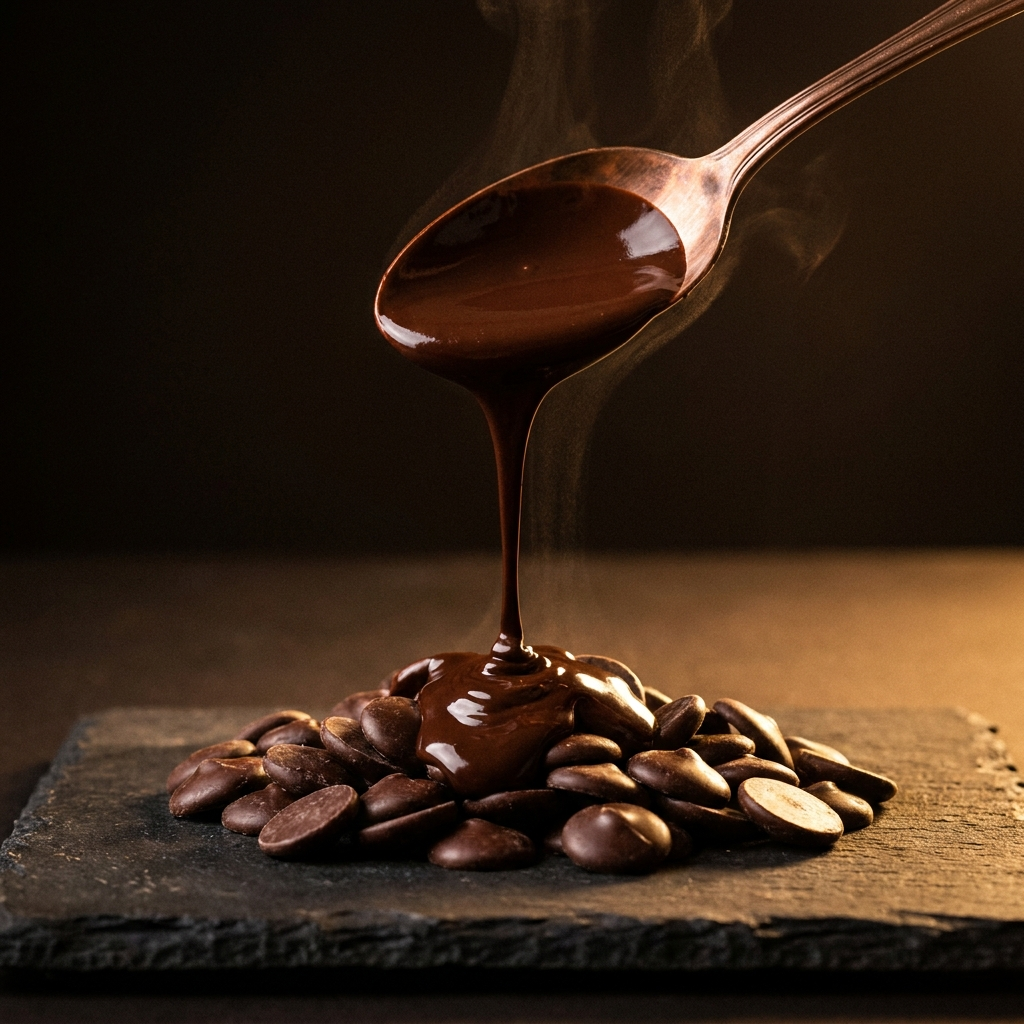
In this guide we set out the exact working temperatures for every type of chocolate, along with three tempering methods that work just as well in the home kitchen as in a small patisserie. We work with ADIKAM chocolate in callet form, which thanks to its uniform size melts evenly and makes temperature control easier.
Why tempering matters at all
If you melt chocolate and let it set without controlling the temperature, the cocoa butter crystals form chaotically, in unstable shapes. The result is dull chocolate that sticks to your fingers, melts easily in the hand and over time develops a pale film (fat bloom). Tempering forces the formation of stable form V crystals only, which build a dense, orderly structure.
What well-tempered chocolate gives you
- A mirror-like surface shine
- A hard, clean snap when broken
- Contraction as it cools - easy release from praline moulds
- Resistance to blooming and longer freshness
- A pleasant melt only in the mouth, not in the hand
The temperature chart - the heart of the process
Every type of chocolate has its own temperature range, because they differ in cocoa butter and milk content. The values below are a reliable starting point. Always work with a digital thermometer accurate to 0.5°C.
| Type of chocolate | Melting (max) | Cooling | Working temperature |
|---|---|---|---|
| Dark 72% | 45-50°C | 27-28°C | 31-32°C |
| Semisweet 54% | 45-48°C | 27-28°C | 31-32°C |
| Milk 32% | 40-45°C | 26-27°C | 29-30°C |
| White-chocolate-flavour coating | 40-45°C | 25-26°C | 28-29°C |
The rule is simple: the more milk and sugar in the composition, the lower the working temperatures. A creamy milk mixture needs gentler handling than an intense Dark 72%.
Method 1 - seeding, the simplest and most reliable
This is the method we recommend to start with, because ADIKAM callets are perfectly suited to it - they act as a "seed" of ready-made crystals.
- Weigh out the chocolate and set aside 25-30% of the callets - this will be your seed.
- Melt the remaining 70-75% in a water bath or microwave (in 20-second bursts) to the melting temperature from the chart.
- Take the bowl off the heat and tip in the reserved callets, stirring continuously with a spatula.
- Keep stirring until all the callets have dissolved and the temperature drops to the working range.
- If a few pieces refuse to melt and the temperature is already too low, fish them out - they have done their job.
Method 2 - tabling (on marble), the professional classic
- Melt all the chocolate to the melting temperature.
- Pour two-thirds of the mixture onto a cool, smooth slab (marble or granite).
- Spread and gather the chocolate with a spatula and scraper, keeping it moving the whole time, until it thickens and cools to the cooling temperature.
- Return the cooled mixture to the rest of the warm chocolate and stir - the temperature will even out to the working range.
Method 3 - controlled water bath, when you have no marble
- Melt two-thirds of the chocolate over steam to the melting temperature.
- Take it off the steam and add the remaining third of the callets in batches, stirring until the mixture cools to the working temperature.
- If needed, reheat briefly (a few seconds over steam), taking care not to exceed the upper limit of the working range.
The temper test - check before you fill the moulds
Spread a thin layer of chocolate on a knife or a strip of parchment and leave it at room temperature (18-20°C). Well-tempered chocolate will set in 3-5 minutes, glossy, even and streak-free. If after 10 minutes it is still soft or grey streaks appear, the tempering has failed and you need to start again.
The most common mistakes
- Overheating - above 50°C you destroy the structure and start from scratch. Milk and white-chocolate-flavour coating are especially easy to scorch.
- Water in the chocolate - even a drop of steam condensing from the lid will cause the mixture to seize and thicken into lumps.
- Too cold a room - work in a room at 18-22°C. In too cool a room the chocolate crystallises too fast and unevenly.
Frequently asked questions
Can I re-temper the same chocolate? Yes. Chocolate that has set badly can be melted and re-tempered again and again, as long as you never overheat it and protect it from water each time.
Why are callets better than a block? Callets are all the same size, so they melt evenly and without hot spots, and they also work brilliantly as a seed in the seeding method.
How long does chocolate hold its working temperature? The mixture cools as you work, so keep it over a gently warm water bath (around 30°C) or reheat it in bursts, keeping an eye on the thermometer.